
Wulida, Maulana (2026) Kolaborasi Model Penta Helix dalam Pengelolaan Pariwisata Desa (Studi pada Desa Pupus, Kecamatan Ngebel, Kabupaten Ponorogo). (Penta Helix Model Collaboration in Village Tourism Management (Study in Pupus Village, Ngebel District, Ponorogo Regency)). Masters thesis, Universitas 17 Agustus 1945 Surabaya.
 |
Text
cover.pdf Download (2MB) |
|
Text
bab 1.pdf Restricted to Repository staff only Download (256kB) |
|
Text
bab 2.pdf Restricted to Repository staff only Download (403kB) |
|
Text
bab 3.pdf Restricted to Repository staff only Download (302kB) |
|
Text
bab 4.pdf Restricted to Repository staff only Download (543kB) |
|
Text
bab 5.pdf Restricted to Repository staff only Download (264kB) |
|
Text
lampiran.pdf Download (521kB) |
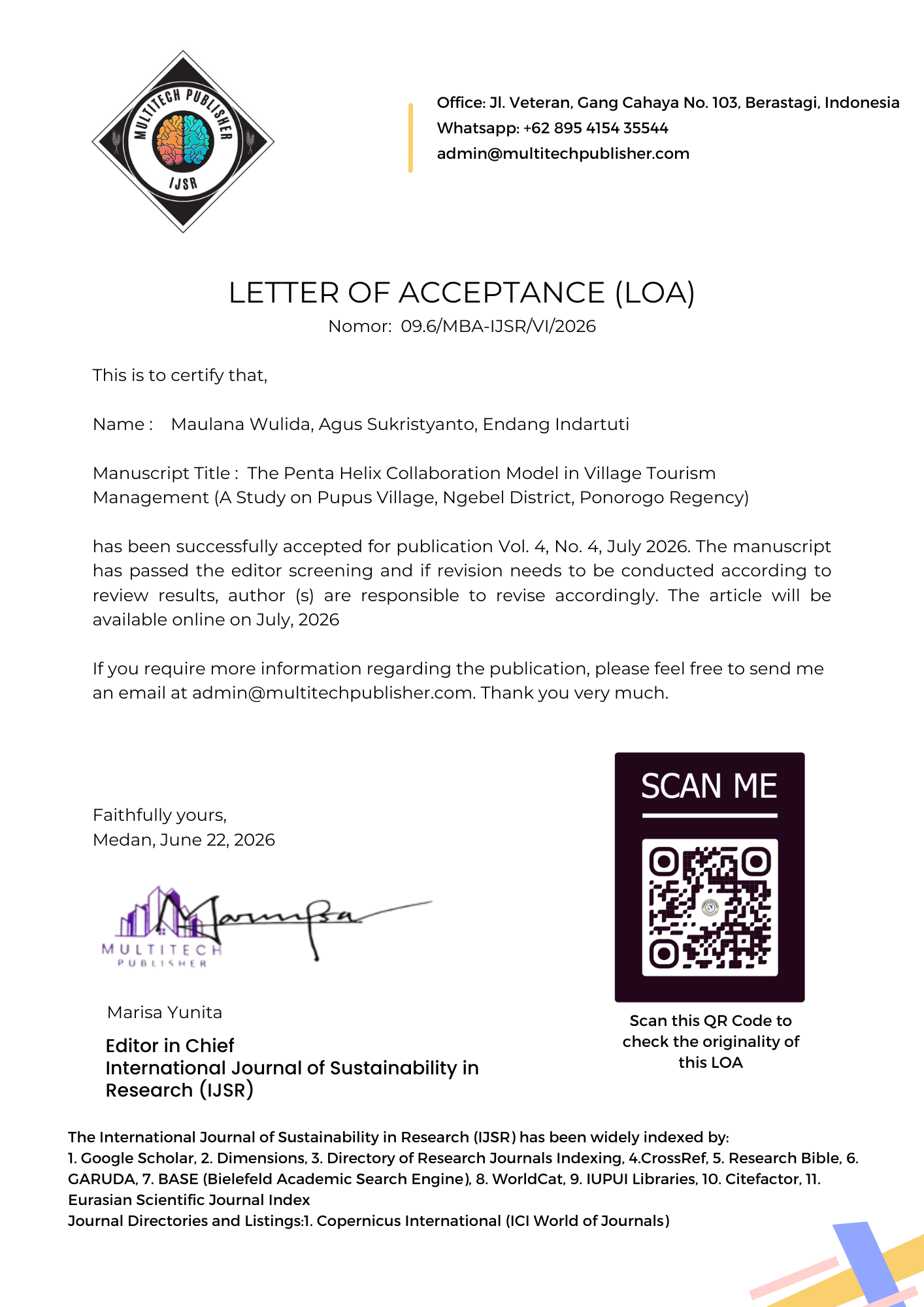 |
Image
MAULANA WULIDA.png Download (452kB) |
|
Text
maulana wulida.pdf Restricted to Repository staff only Download (60kB) |
|
Text
6-IJSR-Maulana+Wulida-MULTITECH.pdf Restricted to Repository staff only Download (317kB) |
Abstract
This study examines the implementation of cross-sectoral collaboration in tourism management in Pupus Village, Ngebel District, Ponorogo Regency. The objective of this research is to describe the Penta Helix collaboration model and identify its obstacles and supporting factors. A descriptive qualitative method was utilized with data collection techniques comprising observation, in-depth interviews, and documentation. The research informants included academics, village government officials, MSME managers, BUMDes/Pokdarwis communities, and media managers. The findings indicate that collaboration operates effectively through the roles of academics (providing innovation and management mentoring), business (MSMEs providing agrotourism products), community (acting as the operational drivers of tourism), government (serving as regulators and infrastructure facilitators), and media (handling digital promotion). However, this implementation encounters several obstacles, such as low participation from certain community segments, limited human resource quality, inadequate road infrastructure, and seasonal dependence on specific tourism products. The primary supporting factors include absolute legality through Village Regulation Number 5 of 2025, regular coordination among stakeholders, mentoring support from the regional government, and the high efficacy of social media promotion. In conclusion, the Penta Helix model has been well implemented but requires continuous strengthening of infrastructure and human resource capacity.
| Item Type: | Thesis (Masters) |
|---|---|
| Uncontrolled Keywords: | Tourism Village, Collaboration, Penta Helix, Sustainable Tourism |
| Subjects: | H Social Sciences > H Social Sciences (General) |
| Divisions: | Fakultas Ilmu Sosial dan Ilmu Politik > Magister Ilmu Administrasi |
| Depositing User: | 116250000 Maulana Wulida |
| Date Deposited: | 02 Nov 2026 02:31 |
| Last Modified: | 02 Nov 2026 02:31 |
| URI: | http://repository.untag-sby.ac.id/id/eprint/48796 |
Actions (login required)
 |
View Item |
